The Traveller's Friend : Travel the Zambezi - Botswana, Mozambique, Namibia, Zambia and Zimbabwe.
Showing posts with label flora. Show all posts

Monday, 11 August 2014

Feeling Blue

By Evelyn Roe, Botanist with North-West Naturalists' Society of Zambia

Does Lobelia feel blue? Is Wahlen bergia ringing a sad note from its bell-like flower? Maybe they’re a little lonesome because blue is rare in the plant kingdom, occurring in less than 10% of the world’s 350,000 flowering plant species.


Aptosimum decumbens

In the Livingstone area, we seem to have our fair share of floral blueness, from the delicate petals of Lobelia kirkii which grace the paths at the Victoria Falls, to the dense hairs in which the stamens of Cyanotis longifolia are enmeshed; and from the creeping Aptosimum to the climbing Evolvulus, both of which bear blue-hued tubular flowers.


Cyanotis longifolia

However, some plant families cannot produce blue flowers, not even under duress! Horticulturalists have been trying for decades to produce a blue rose, but the latest genetic technology has managed only a pale imitation - a lilac rose.


Wahlenbergia_denticulata

So, what is the secret of the blue-flowering plant?

Certain families are capable of performing a kind of floral magic. First, they make red anthocyanins, which are found commonly in the plant kingdom, and store them in the watery vacuoles of their cells. Later, they transform them into blue pigments when they have the right conditions of light, acidity, a supply of particular metal ions, and a stack of other essential plant chemicals. The complexity of the transformation has been noted by scientists, but exactly how it happens remains a mystery.


Evolvulus alsinoides

We might ask, is flower colour significant for the plant? Many birds and insects are attracted to blue flowers and harvest their nectar, helping with pollination on such feeding forays. However, they also visit flowers with red and yellow hues, so it’s difficult for researchers to work out what it means to be blue. Perhaps it’s not the outward appearance of blueness that makes a difference; it could be that other qualities of the pigments– such as their metallic nature - influence the plant’s development and wellbeing.


Commelina forskaolii

In Tradescantia, which is a close relative of Commelina and Cyanotis, the blue stamen hairs mutate to pink in the presence of nuclear or chemical pollution. Experiments over the past 40 years have shown that spiderwort, as Tradescantia is commonly known, can be used as a reliable detector of such environmental contaminants.


Lobelia kirkii

In some cultures, the blue flower is a symbol of inspiration, hope and love. It can also represent the striving for the divine, and the merging of the self with nature. How does this tie in with our association of the colour blue with feelings of sadness, I wonder? Perhaps the coolness and spaciousness of the Earth’s azure skies and deep-blue seas create feelings of alone-ness; or maybe our human striving for union with the divine and the infinite is simply unreachable and unobtainable...just like the blue rose.

More from this issue:
ZT17 (June 2014) - Main Menu
ZT17 (June 2014) - Full Content Listing

More from the Zambezi Traveller:
Livingstone News

More articles in this series:

Silent Trumpets (ZT, Issue 16, Mar 2014)
Christmas crackers (ZT, Issue 15, Dec 2013)
Don't eat the daffodils (ZT, Issue 14, Sept 2013)
Rainforest Riches (ZT, Issue 13, June 2013)
Berry banquet (ZT, Issue 12, March 2013)
Marvellous Mangoes (ZT, Issue 11, December 2012)
Underground Forests (ZT, Issue 10, September 2012)
The healing powers of Aloes (ZT, Issue 09, June 2012)
Dogbane Drugs (ZT, Issue 08, March 2012)
Devil’s Claw (ZT, Issue 07, December 2011)
Elephant Toothpicks (ZT, Issue 06, Sept 2011)

Wednesday, 18 September 2013

The healing powers of Aloes (ZT09, June 2012)

From the Zambezi Traveller online article archive.

The healing powers of Aloes
By Evelyn Roe, Photographs by Helen Pickering


Aloe cryptopoda

History records the importance of aloe plants: Alexander the Great conquered the island of Socotra for its extensive Aloe vera plantations; according to the Bible, the body of Jesus was wrapped in aloe leaves when removed from the cross; and the victims of atomic bombs dropped on Hiroshima and Nagasaki were successfully treated for radiation burns with aloe leaf gel.

Aloe plants have succulent leaves made of two main parts: the green outer rind, which contains vessels that release a bitter yellow latex when cut; and the inner colourless pulp, which can be removed like a fillet to prepare aloe leaf gel from the liquid inside the cells. The latex contains aloin, a powerful laxative, whereas the watery gel consists of a wide range of compounds that assist in healing damaged skin and internal membranes, and in balancing the immune system.


Aloe chabaudii

Centuries of anecdotal evidence support Aloe vera’s therapeutic properties, which scientists have long sought to understand in terms of individual chemical components. Recent research shows that the effectiveness of aloe gel comes from the synergistic action of many types of molecules, rather than a single compound, and its anti-bacterial, anti-inflammatory, anti-diabetic (and many other) properties have been verified, if not fully understood.


Aloe cryptopoda

Zambia has 21 of the world's 400 or so aloe species, six of which occur in Southern Province: Aloe excelsa (also known as Zimbabwe aloe), is found in this country in only one locality in Kafue Gorge and is therefore listed as ‘Vulnerable’ in Zambia's Red Data List. The others are A. chabaudii, A. christianii, A. cryptopoda, A. greatheadii, and A. zebrina.


Aloe zebrina

Local uses include adding aloe gel to chickens' drinking water to treat a range of diseases, and dipping poultry in a leaf infusion to discourage parasites. The nectar-filled flowers are edible and can be dried and pressed into cakes.

I often harvest gel from A. chabaudii to treat dry or sunburned skin, and perhaps other local species could be used beneficially, but do not ingest aloe gel unless it has been tested for safe internal use.

More articles in this series:
Rainforest Riches (ZT, Issue 13, June 2013)
Berry banquet (ZT, Issue 12, March 2013)
Marvellous Mangoes (ZT, Issue 11, December 2012)
Underground Forests (ZT, Issue 10, September 2012)
The healing powers of Aloes (ZT, Issue 09, June 2012)
Dogbane Drugs (ZT, Issue 08, March 2012)
Devil’s Claw (ZT, Issue 07, December 2011)
Elephant Toothpicks (ZT, Issue 06, Sept 2011)

Monday, 8 July 2013

Rainforest riches

Text and Photograhs by Evelyn Roe


The neck of the Falls

Luxuriant vegetation cloaks the cliff-tops of the Victoria Falls and drapes down into rocky crevices soaked by swirling spray. For many months of the year, this oasis brings forth flowers of all colours of the rainbow, and harbours delicate ferns and mosses. The tiny woodland, perched atop basalt stacks, is fondly known as ‘the rainforest,’ due to its unique spray-moistened micro-climate within an otherwise parched landscape. Strictly speaking, it is not one of the world’s true rainforests, which are characterised by a minimum annual rainfall of nearly 2000 mm (80 inches). Despite this, when you teeter along cliff-edge paths to catch glimpses of the roaring falls through curtains of rising spray, you could easily imagine you’re in the jungle.


Lobelia kirkii

Imagine how thrilling it must have been for the European botanist, Sir John Kirk, who accompanied David Livingstone on his 1860 expedition, to meet for the first time the exquisite lobelia, subsequently named after him: Lobelia kirkii. You can find this endemic species along the paths opposite the Eastern Cataract in Zambia.


Gladiolus dalenii

A little further along, the yellow Gladiolus dalenii graces the grassy slopes of Knife-Edge Island, where the forest holds a diversity of edible plants.


Phoenix reclinata

The wild date palm, Phoenix reclinata, bears sweet fruits in the late rains and flowers from August to October.


Mimusops zeyheri

Large trees such as red milkwood, Mimusops zeyheri, known locally as muchenenge, produce tasty, but rather mealy fruits throughout the dry winter months.


Carissa edulis

The beautiful shrub, Carissa edulis, also bears fruits which can be eaten when they turn black.


Feretia aeruginescensare

Like the true jungle, the ‘rainforest’ at the Falls is a treasure-trove of medicinal plants. Shiny fruits of the pink medlar, Feretia aeruginescensare reported to treat infertility. The fruits are dried in the sun, powdered and dried further, then stirred into the morning cuppa!


Plumbago zeylanica

The sub-shrub, Plumbago zeylanica, or kalutenta, has been scientifically proven to have anti-microbial and anti-fungal properties. Its white tubular flowers can be seen for much of the year in shady, damp areas.


Strophanthus kombe

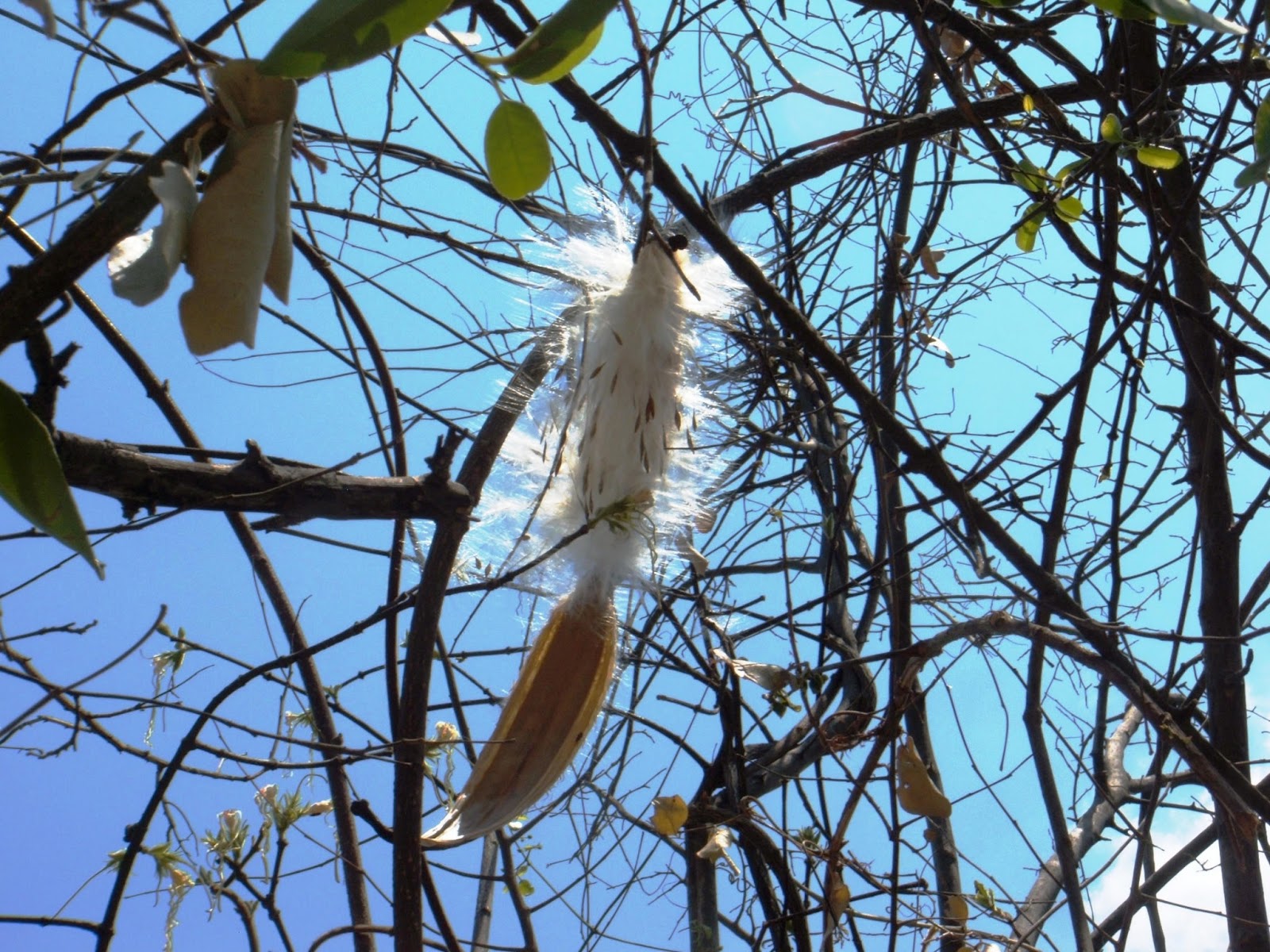
As you wind your way back towards the entrance gate on the Zambian side, keep your eyes open for the kombe vine, Strophanthus kombe, which grows high overheadnear the long flight of stone steps. It produces seeds containing a poisonous compound, strophanthin, which slows down the heart and is used during heart surgery. The seeds are released from paired pods, which split open during the dry winter months and release a mass of white fluff.

This is just a small sample of all that nature has to offer, in the unique ‘rainforest’ at the World Heritage Site.

More articles in this series:
Rainforest Riches (ZT, Issue 13, June 2013)
Berry banquet (ZT, Issue 12, March 2013)
Marvellous Mangoes (ZT, Issue 11, December 2012)
Underground Forests (ZT, Issue 10, September 2012)
The healing powers of Aloes (ZT, Issue 09, June 2012)
Dogbane Drugs (ZT, Issue 08, March 2012)
Devil’s Claw (ZT, Issue 07, December 2011)

Did you know you can download a pdf version of the current, and past issues, of the Zambezi Traveller online:
Zambezi Traveller Downloads